

Alexia O’Brien
Alexia O’Brien is Housing Policy Advocate at the Jesuit Centre for Faith and Justice. She is primarily focused on research and advocacy relating to the production of housing and living conditions. She holds a PhD in Geography from Trinity College Dublin.
Introduction
Unpacking the current state of Irish housing could be a whole Working Notes issue in itself. The longer it goes on, the more we are starting to reject the notion of “the housing crisis”. What we mean by that is that this now goes so far beyond one crisis, and treating it as one problem is, quite frankly, one of the reasons we got to where we are today. We have an affordability crisis, social housing crisis, private rented crisis, access to homeownership crisis, student accommodation crisis, accessible friendly homes crisis, and so on and on. They are so interconnected with each other and yet so massively complex in their own regard that treating them as the same thing continues to fail those that are afflicted by that specific crisis (or multiple crises at once for many people!). Because this problem is so diverse and so deeply rooted into the housing system, it can be easy to feel defeated and like the system will never change. Nevertheless, this is not an option, not for the country and not for the Jesuit Centre. Our beliefs, convictions, and practices hold firm, now more than ever.
OUR PAST WORK ON HOUSING
While the Centre’s inception grew from helping the community find gainful employment (quite literally why our publications are called Working Notes), inspired by the work of Peter McVerry SJ, a founding member, housing as always been a policy issue addressed by the Centre. The crash of the Celtic Tiger in 2008 led to housing becoming a core piece of research and advocacy, with the first major piece of writing being The Irish Housing System: Vision, Values, Reality in 2009. Since then, we have published Rebuilding Ireland – A Flawed Philosophy (2017), Tenant State of Mind (2022), Cost Rental in Ireland: A Proposal Towards a Public Housing System (2022), and Using the Kenny Report to End Land Hoarding (2025), as well as providing resources on the EU Affordable Housing Plan and how current Irish policies align with it. All this being said, arguing for a just housing system is not new to us. In fact, we are doubling down on our stances. Since the publication of The Irish Housing System, the housing crisis has turned into the housing crises. We solve this by taking what the Government would see as a “radical approach”, when really, it is basic maths:
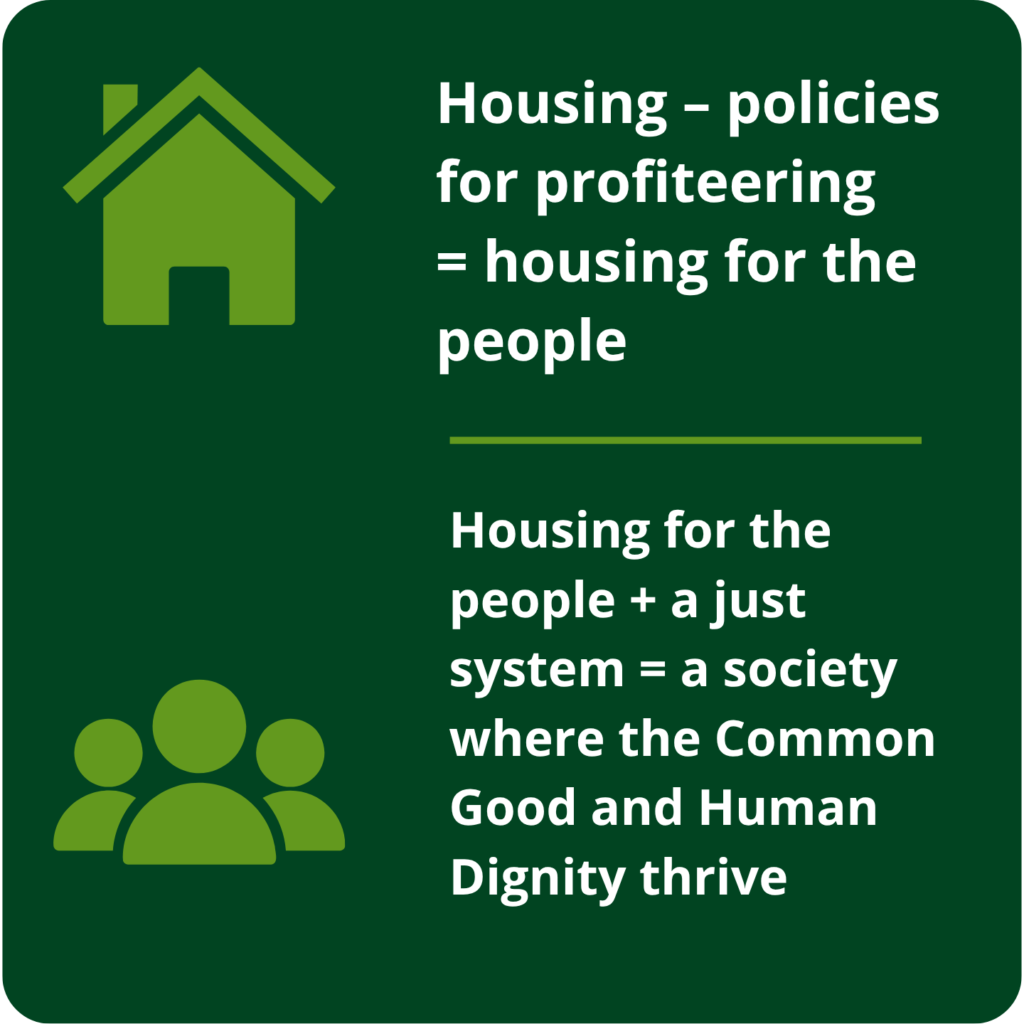
This, of course, is not good for the 1% of people who have created the current conditions of exploitation and gross profits lining their pockets. This deep indifference for the majority of people is felt strongly throughout the country, but there is a particular level of disdain for the people by the Government and investors that happens in Dublin, and even more acutely in Dublin’s Inner City.
WHERE WE SIT: LITERALLY
The physical location of our office is not by chance. Sure, we sit within the Jesuit Church behind St. Francis Xavier, and as a Jesuit research centre, that makes sense. However, beyond that, being on Gardiner Street in the heart of Dublin’s North East Inner City (NEIC) and staying here has been a choice that reflects our wider mission: to be where it matters. Not just in research or with professional networks, but to be with the community and to be where our work can be most valuable.
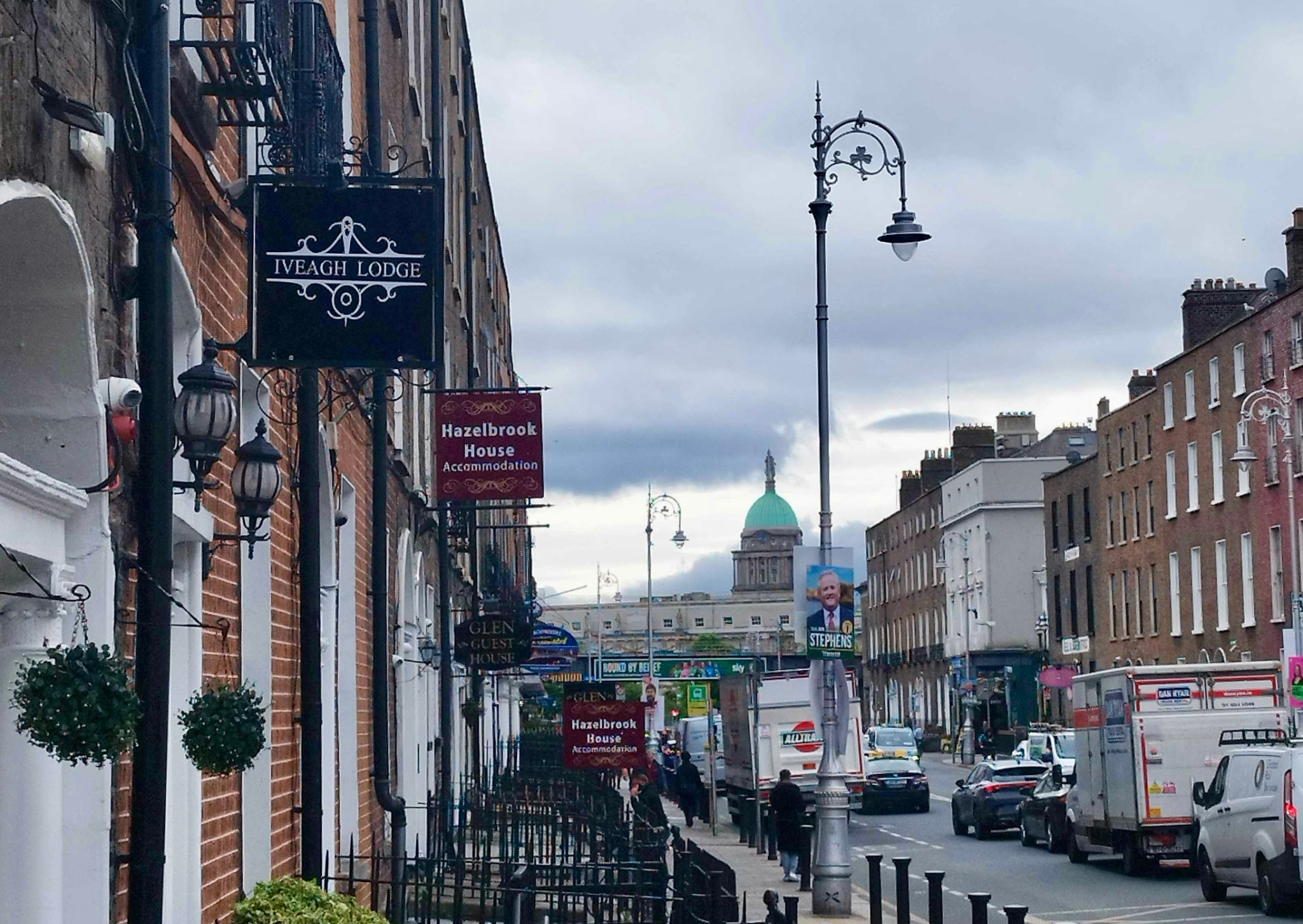
Gardiner Street has long been an important street of temporary shelter, historically as bed and breakfasts, inns, and guesthouses for those needing to go to and from Connolly Station. The lower part of the street nearest to the station is lined with short-term accommodation buildings, reflecting its historical importance. In recent years, though, these short-term accommodations for tourists and travellers have been converted into emergency accommodation for homeless individuals and families. Half way up the street is a shiny new student accommodation block, further evidence of the changing demographics and systems at work between the Georgian houses.
The growing tensions between the wants and needs of the residents versus what the city council is providing is stark. Under the guise of working on eliminating anti-social behaviour, the council have proposed cutting one of the few precious amenities on the street. They wish to do away with the football and basketball pitches in Mountjoy Square and refurbish it as an ode to the Georgian era. While this may seem unconnected to housing, it directly impacts it. Why would a family want to move to an area that their children are not allowed to play in, and why would we tell those looking to move to a safer area that the activities that promote positive social behaviour and keep an area safe are no longer available?
The street has been in the focus of recent news around housing, particularly in relation to homelessness and the extent of emergency accommodation I just mentioned. RTE’s Prime Time ran a feature on Gardiner Street in February of this year, where local activists, politicians, and educators highlighted the challenges faced.1 One of the more shocking figures to be presented is that 1 in 10 homeless people in Ireland is residing on this one street, much of it concentrated in the lower half. 20 short term accommodations have been turned into homeless accommodation, with nine of those being designated for families. This, of course, has a direct impact on the children living in these conditions and their ability to grow and thrive. Our neighbouring Jesuit school, Gardiner Street Primary School, is reporting that 20% of their student body is homeless and in emergency accommodation.
How do we as a country find this to be an acceptable reality?
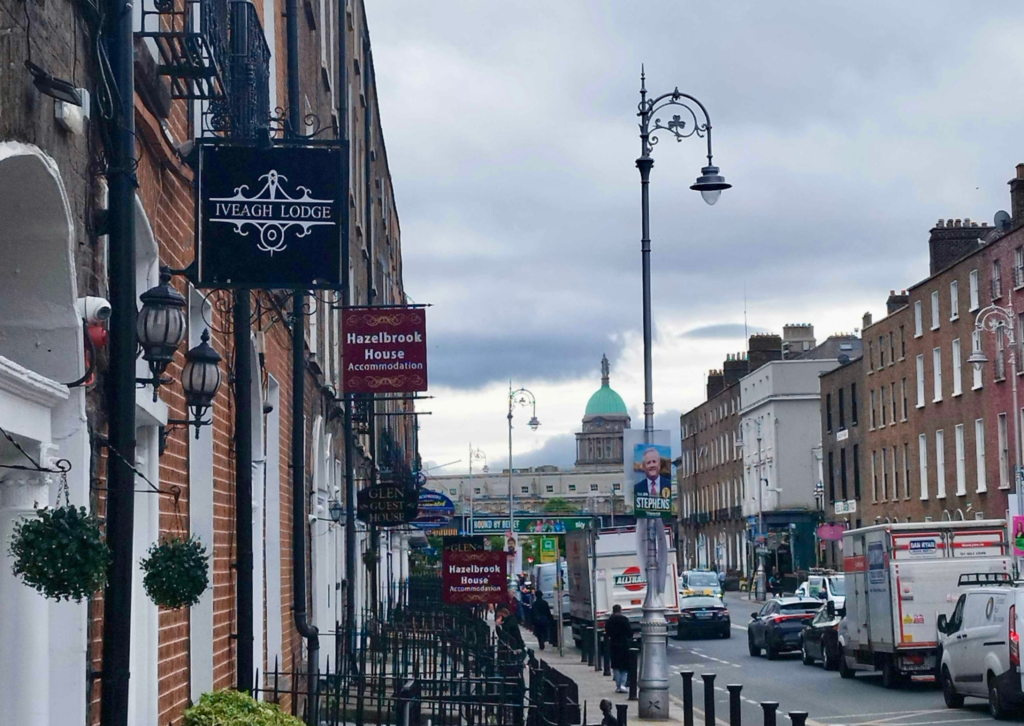
The wider NEIC as a whole sees all housing systems working, between social housing, private rented, homeownership, and as mentioned, student accommodation and homelessness services. This area is also rich with faith-based communities, where the positive work of our parish is only one aspect of the growing microcosm of faith-led approaches to bettering our communities.2 It is where the policies of the government are felt on the ground and have been—unfortunately—made to leave people feel like it is an undesirable place to live while also producing undesirable living conditions. The growing anti-migrant rhetoric places Dublin 1 at the epicentre,3 where our rich diversity is what makes this area a cultural hub. Sadly, these are the exact people who are getting stuck in poor housing and overcrowding due to our worsening housing crisis and the inability to find a place to rent until they arrive, or alternatively, actively stuck in poor accommodation because they cannot find anywhere better within their budget. This is not unique to migrants, however, and is a problem for every resident of Ireland, citizen or not.
WHERE WE SIT: IDEOLOGICALLY
In a time where division seems more prevalent than unity, we must remember that unity is what makes us stronger. Our allies must remain our allies, and Ireland is fortunate to be in a strong partnership through the European Union. We learn from each other, the good and the bad, and we work together in creating a better place to live. We must, as a country, continue to strive for reaching the bar our EU friends are setting, but also to be the country that others look to and strive to meet.
There are two main ways that Ireland could majorly benefit by doubling down on our European stance, both ways JCFJ have already taken in our approaches. The first is our belief in how we understand homelessness, understanding that it goes behind how the government calculates it4 and encompasses rough sleeping on the street, couch surfing, living in transitional/temporary homes, overcrowded living, domestic violence refuge shelters, and refugee centres—all of which we refer to as “hidden homelessness”.5 This is more in line with the European Commission backed FEANTSA’s European Typology of Homelessness and housing exclusion (ETHOS) scale that categorizes homelessness into six operational categories: people living rough, people in emergency accommodation, people living in accommodation for the homeless, people living in institutions, people living in non-conventional dwellings due to lack of housing, and homeless people living temporarily in conventional housing with family and friends (due to a lack of housing).6
The second is our support for the European Affordable Housing Plan that was released late 2025. The release of the Plan is deeply welcomed by us, as we have consistently been arguing for affordable housing in all forms (see Cost Rental in Ireland7) and will continue to do so. Affordable housing is, like our argument for calculating homelessness, not just one typology the government assigns, but rather a structural reform that means affordable homeownership and affordable renting both in public and private sectors. The EU Plan provides a pathway forward in achieving this ambition while also reaffirming our commitment to being a European and leading the world towards more sustainable practices in every sense of the word.
WHERE DO WE GO FROM HERE?
It is the tradition of JCFJ to push back on the narratives being given to us by the Government and to fight for justice for all. In our very first Working Notes, we challenged the so-called success of the new Jobsearch programme, arguing that the new figures released were not new numbers, but rather “simply a part of [the original data] presented under a new heading”.8 The willingness to challenge the Government and its data was not necessarily monumental, but was significant nonetheless. It solidified to the people where we as a Centre and Church stood and has continued to provide us the confidence in being a research body that will openly and willingly call out injustice to the people, regardless of who we stand against.
Building on this history, we will continue to call out moments of wider structural weaknesses when it comes to how we understand and approach housing. This means continuing to argue for better recognition from the government on what homelessness actually is and not allow them to cherry pick numbers which show them in a better light. It is reminding the people that when something is called “affordable”, that doesn’t make it so. It means continuing to work with other researchers and the community to amplify the voices of the many and those that are all too often silenced. It means creating a place where our youth don’t feel the need to emigrate and yet can come home if they choose so and not be destitute to their family homes due to costs.
Moving forward, the Centre will continue to work on issues of hidden homelessness, where we have been undertaking research on understanding hidden homelessness in the area through a means of exploring the various ways of exploitation that is happening in our immediate area, of which, further identifies the levels of homelessness and brings us closer to a European understanding. Additionally, with the new EU Affordable Housing Plan clearly outlining the goals of member states, we will be keeping a close eye on Ireland’s willingness to follow an evidence-based approached to tackling unaffordability, continuing to make it known when they are or are not succeeding.

The idea of home sits at the very heart of the Christian tradition. The Irish Catholic bishops have consistently denounced the present approach, insisting that “housing should not be treated in the same way as any other commodity.”9 Irish theologians have been at the forefront, globally, in addressing this issue. Ethna Regan has written about how housing is “a demand of the common good, a basic right, and a necessity for a truly human life.”10 Suzanne Mulligan has warned about technocratic approaches which imagine this crisis as a puzzle to be solved by policy experts: “We must think of housing in a new way, and crucially we must learn from those who are unhoused.”11 Those most afflicted by the crisis should be central in the resolution. And Siobhán Garrigan has compellingly presented the secure sense of being at home as something more profound than merely providing housing. She notes that “home” can function in English as a verb. It is, she maintains that to home involves being “open to the future, open to the stranger, open to the other.” Ultimately, for Christians, to provide a home is to provide the context where a person can be “open to the Spirit.”12 The Centre intends to bear witness in its work to this rich, holistic vision of what it means to provide home (and what it means to deprive people of home). As Pope Francis noted:
Lack of housing is a grave problem in many parts of the world, both in rural areas and in large cities … Not only the poor, but many other members of society as well, find it difficult to own a home. Having a home has much to do with a sense of personal dignity and the growth of families. This is a major issue for human ecology.13
Conclusion
Ireland has a long way to go when it comes to tackling “The” housing crisis. For starters, we need to be real about what our problems are— you cannot slay the beast if you don’t know what the beast is. This means homelessness figures that more accurately reflect the state of homelessness in the country. It also means acknowledging that we have been alienating a substantial portion of the population by allowing rental and purchase prices to continue to be so far out of reach. Enough of hiding the truth and enough of putting the self-interests and interests of the investors first. It is time to get real and face the music, because maybe then we might start making some real progress and change. While it at times even we feel like we are screaming into the void, we know we are not. Our mission to do justice for all drives our motivation and a willingness to spearhead and support research that will lead to a betterment of the people. We will continue to build on our legacy as a reputable source of research while also speaking truth to power, guided by our faith and desire to take care of one another. We know our “radical ideas” are not radical, and the Centre will continue to push for a housing system that works for all and not few. Only through this will meaningful change happen.
Footnotes
- Louise Byrne, “One in Ten Homeless People in Ireland Living on One Dublin Street,” RTE, February 13, 2026, https://www.rte.ie/news/primetime/2026/0212/1558240-one-in-ten-homeless-people-in-ireland-living-on-one-dublin-street/. ↩︎
- Keith Adams et al., Faith in the North-East Inner-City: How Faith-Based Communities Help Dublin Flourish (Jesuit Centre for Faith and Justice, 2025). ↩︎
- Back in November 2024 following the stabbing of primary school children, rumors flew quickly and widely that an illegal migrant was to blame for the horrendous act. This was proved to be false, but chaos erupted and riots broke out across Dublin, much of which happening in Dublin 1 and the NEIC, centred around the idea that migrants were ruining Ireland. ↩︎
- Currently, Ireland calculates their homeless numbers as only those in emergency accommodation. This has drawn much criticism over the years, as this a) does not accurately reflect the real homelessness epidemic, and b) is not how we have always calculated our figures. Prior to 2015, those in refuge centres were included in homelessness statistics released by the Government. Even more controversially, a decision in 2018 by the Government re-categorized how to define emergency accommodation, excluding any types of emergency accommodation that operated through individual apartments/houses, arguing it is not considered emergency accommodation if it is owned by a local authority or an Approved Housing Body. Eoin O’Sullivan, Measuring Homelessness in Ireland (2018), Dáil Submissions ↩︎
- Rory Hearne and Kenneth McSweeney, Ireland’s Hidden Homelessness Crisis (Maynooth University, 2023). ↩︎
- ETHOS Light: European Typology of Homelessness and European Exclusion, 2026. ↩︎
- Keith Adams et al., Cost Rental in Ireland: A Proposal Towards a Public Housing System (Jesuit Centre for Faith and Justice, 2022). ↩︎
- Working Notes 01 (Jesuit Centre for Faith and Justice, 1987) ↩︎
- Irish Bishops’ Conference, A Room at the Inn? (Irish Episcopal Conference, 2018), 10. ↩︎
- Ethna Regan, Catholic Social Teaching and Homelessness: The World Tribe of the Dispossessed, 4, no. 1 (2019): 28 ↩︎
- Suzanne Mulligan, “Homelessness: Some Theological Reflections,” Studies: An Irish Quarterly Review (Dublin) 112, no. 448 (2023): 446. ↩︎
- Siobhán Garrigan, A Theology of Home in a Time of Homelessness (Cambridge University Press, 2025), 58–59. ↩︎
- Pope Francis, Laudato Si’ (Catholic Truth Society, 2015), §152 ↩︎