
For this issue’s “Can I get a witness?” Niall Leahy SJ interviews Sophie Manaeva. Sophie is a full-time graduate student at TCD and part-time theological research assistant at JCFJ.
NL: Sophie, your full-time occupation is as a student. Could you tell me what course you’re doing and what kind of knowledge and skills you’re learning on that course?
SM: I’m doing a Master’s in Theology and Social Justice at Trinity College Dublin. It’s a collaboration with the Jesuit Centre for Faith and Justice, and it approaches theology from a policy perspective. So it equips the students with theological skills and knowledge, while at the same time critically looking at policy and how that is affected by the kind of theological and philosophical stories we tell—and how that can enable social justice and social change.
NL: So there’s a certain intellectual excavation going on, or digging down into hidden assumptions about policy today?
SM: I think the module on economic justice has been eye-opening for me, just because of how implicit this ideology of maximizing profit is—how ubiquitous it is throughout society—and how we apply it to areas like housing and environment where maybe we shouldn’t. And being equipped with a theological perspective on that, as well as the political and economic background, has been really eye-opening and really helpful.
NL: And are there any ideas that have particularly grasped you or inspired you in your studies?
SM: That’s very hard to narrow down. I think, for me, in the economic justice class, the field of heterodox economics has been really interesting—particularly when it’s aided by theological ideas as well. So, ideas like the Economy of Communion, the Economy of Francesco, Bruni and Zamagni’s Civic Economy, and Kate Raworth’s Doughnut Economics—the idea of having both a ceiling and a floor for development and for sustainability. And how it is possible to design an economy with a moral, faith-informed vision. That’s been really transformative for me, theologically.
NL: Did you have an interest in economics before you went into this course, or did that come through the course?
SM: I think I’ve always been interested in social justice, and I’ve always been aware of the economic dimensions to that, and how it kind of makes worse—or makes wider—societal inequalities. But being equipped to think economically through these modules has really developed that for me a lot.
I’ve become a lot better at recognising and thinking about social justice with that added economic dimension. Because I’m coming from a humanities background, through and through—I studied classics and religion in undergrad—so the economic stuff is brand new for me. It’s a new way of thinking, “logically,” I guess. But I really enjoy the challenge. And that’s why I really like people like Kate Raworth and others doing heterodox economics, who are doing economics but not in a simplified way that abstracts out the moral vision of what life should be like.
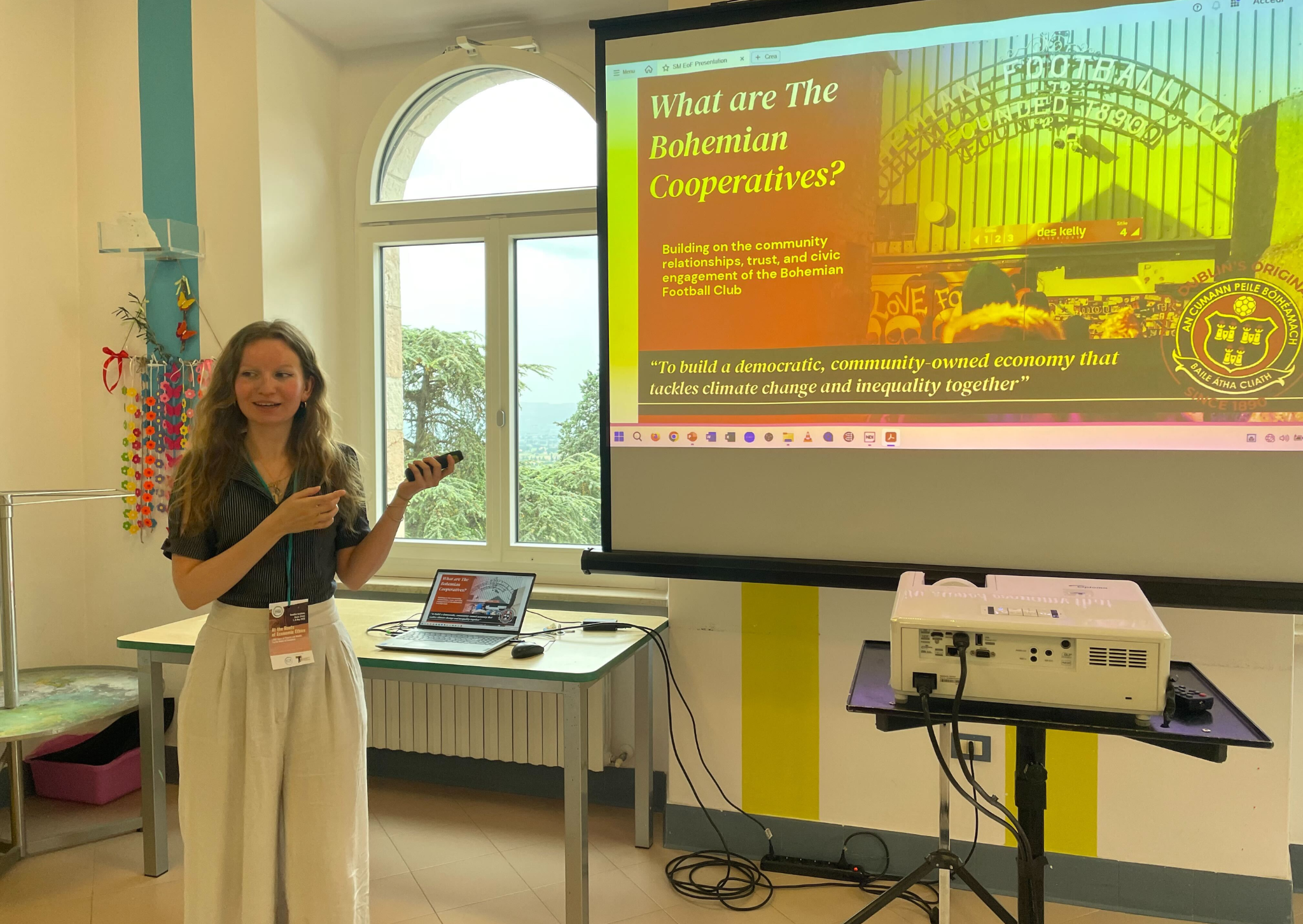
NL: You have also been working closely with Bohemian Cooperatives. Is that a real-life illustration of an economy with morals?
SM: Absolutely. I think that’s what makes it so exciting for me, because it’s such a practical, real-life example of how this can possibly work – how a community can be made to be more resilient and to flourish all together. Working with the team and seeing their dedication, their commitment, and their vision has been really encouraging as well.
NL: What is your work within that team?
SM: So I’m working alongside them to translate this idea of community wealth building into language that’s appropriate to Catholic Social Teaching, in order to sort of widen the net for inclusion – for these new cooperatives and this ecosystem that they’re hoping to build.
I’ve been immersing myself in their work, in the materials they’ve produced, in the reports they’ve made on how community wealth building is working in places like the Basque Country with Mondragon in Spain or Cleveland in the US. I’ve also been able to see how their community-supported agriculture works—how a local farmer comes in and provides packages for families.
It has been just so encouraging to see how dedicated they are, how committed they are to this vision – and how it’s not just aspiration, it’s really happening. There is a solid, strategic plan for how this economy might look in the next three to five years. What I really admire is their willingness and eagerness to collaborate with civil society in all its dimensions, including faith communities, because they understand the importance of having that cultural foundation of cooperation in order to make the economic aspect work. It’s not just about setting up a single cooperative business—it’s about creating and encouraging participation in a cooperative economy.
NL: You have also helped to establish the Economy of Francesco in Ireland. What is it, and why is it something you’re drawn to?
SM: The Economy of Francesco builds on both of these ideas: faith-informed economy and participation. It engages young people: entrepreneurs involved in businesses, changemakers in civil society and advocacy, and intellectuals involved in economics and other disciplines. The goal is to build an economy “with a soul.” I think that expression really captures it. As young people, we can see that, especially in Ireland, housing policy is not sustainable into the future, environmental policy is not sustainable into the future, and a lot of that has to do with economic organisation. So it’s a way for young people to bring their faith to the table and imagine a different vision of the future economy.
NL: Do you think it’s something special in church circles?
SM: It’s definitely special because it is such a strong global movement. There’s so much collaboration and support and inspiration that we can draw from different global contexts, and to see what works. It also platforms success stories – social enterprises or policies that work in specific places. And that’s what we’re trying to do with an Irish hub as well—to bring those kinds of changes into Ireland.
NL: If you could implement a policy right now, what would it be?
SM: Maybe this is a bit narrow, but last year Dublin City Council followed Scotland in establishing community wealth building as a kind of paradigm for economic development in Dublin. It’s still very new, and it hasn’t necessarily gained ground yet. So my hope would be that it would gain momentum, and not just in Dublin, but beyond too. That would help establish an ecosystem of community wealth building here. I think that could be transformational in many areas of life.
SM: Maybe this is a bit narrow, but last year Dublin City Council followed Scotland in establishing community wealth building as a kind of paradigm for economic development in Dublin. It’s still very new, and it hasn’t necessarily gained ground yet. So my hope would be that it would gain momentum, and not just in Dublin, but beyond too. That would help establish an ecosystem of community wealth building here. I think that could be transformational in many areas of life.
NL: On a more personal note, how has all of this affected your own life?
SM: That’s a tough question. But I feel like I’ve become more aware of how community happens. With Bohemian Cooperatives, they always say that they run all these programmes – skills workshops, libraries – but there’s a kind of “hidden agenda” which is to build community beyond just teaching people things. And that has really stuck with me. Just noticing the ways in which community is built every day, through small, regular encounters, and taking people as they are. It really strengthens your relationship to others.
And with things like the Economy of Francesco, it doesn’t just feel like isolated academic ideas – it’s young people coming together, being hopeful about the future. That’s a powerful way of sustaining that hope, and not getting bogged down by how big everything can feel.
NL: Sophie, thank you very much.