

Siobhán McNamara
Siobhán McNamara is Province Ecology Officer with the Jesuit Centre for Faith and Justice
One of the first topics of conversation in the JCFJ when I joined the team in January 2025 was soup kitchens. Dublin City Council had just announced proposals to restrict on-street food provision by charitable organisations. The issue was discussed at the time in a blog post by our colleague Keith Adams who concluded that “if Ireland has soup kitchens, I want them to be visible — however uncomfortable for policymakers — not hidden in the peripheries of the city. I don’t want it to easily slip from my mind that I live in a country that has extraordinary wealth yet has normalised street homelessness and food poverty.”1 Curtailing the ability of charities to feed the hungry in public would do nothing to solve the problem, but it would make it easier for the government and for the rest of the population to turn a blind eye to how many people are experiencing homelessness or food poverty in twenty-first century Ireland.
Also in January 2025, Our Daily Bread was launched in Brussels. This is an ecumenical network of Faith-Based Organisations, including the JCFJ, who advocate for sustainable food policy in the European Union. Using the integral ecology framework, the network’s vision is “a food system where caring for the health of our planet is strongly connected to solidarity with marginalized people” where producers can “enhance
biodiversity, embrace agroecological practices, and protect rural communities.”2
So when it came to choosing an overarching theme for this issue of Working Notes at the beginning of this year, the topic of food—from its production to distribution and consumption—was timely. It was of particular interest to me as editor of the issue because I had just finished a year of weekly volunteer sessions at the FoodCloud warehouse in Tallaght. Here, surplus food from suppliers and supermarkets is gathered and sorted for distribution to a variety of charities and community organisations. The experience had given me some insight into the inefficiencies of our food system, where without a facility such as FoodCloud, truckloads of high-quality, in-date food would end up in landfill every week.
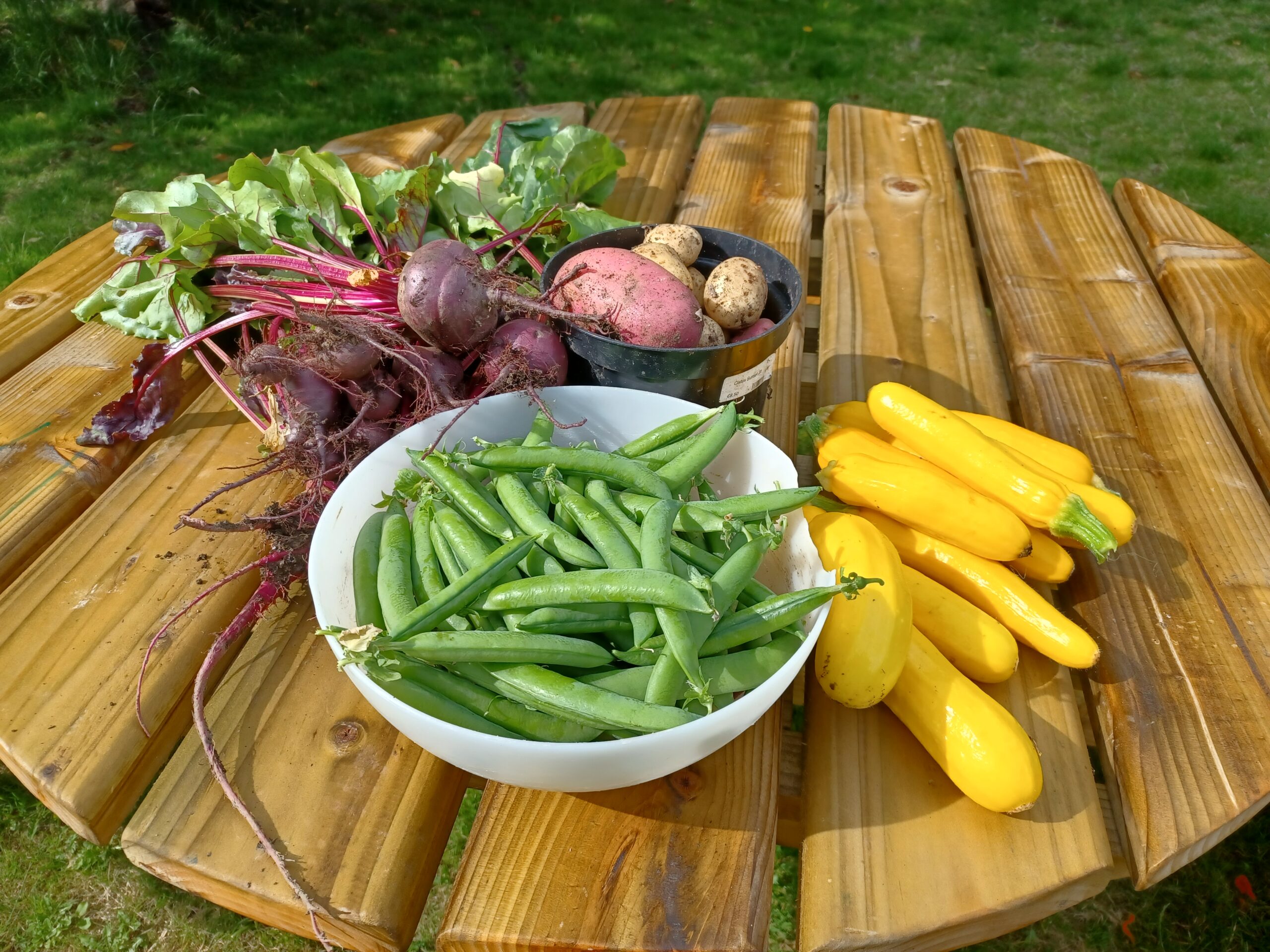
Food has also been central to other voluntary work I’ve been involved in over the past few years. I am part of a volunteer-led community group in Dublin 12 called Bloomin’ Crumlin, which has been a very rewarding experience and has helped me feel much more embedded in the community. Central to our events and activities is appreciating locally-produced food, whether it is grown in our own private gardens, in our community garden or polytunnel, or in a local allotment. The queues of people who have turned up every year to collect fruit trees, berry bushes and herbs during our annual Orchard Project giveaway testify to our community’s appetite for cultivating good food in our small suburban gardens. The recipe ideas shared at our monthly vegetarian cooking sessions nourish our bodies as well as help build new friendships. The energy and commitment of our volunteers who help out in Kyrie Therapeutic Farm3 in Kildare is an inspiration, and their work enables us to buy delicious, seasonal, organic vegetables directly from the producer. These products would cost far more in any local supermarket, if they were
available in the first place.
The ritual of sitting down together to eat is central to the expression of our Christian faith, and food is one of the most fundamental and visible manifestations of how we care for each other. After a recent bereavement in my family, our kitchen spontaneously filled up with food brought by our neighbours and
friends as a way to express their love and support.
If we take Dr Cornel West’s definition of justice as “what love looks like in public” and reflect on how food is produced and distributed in our society, there is a lot we can learn about how we care for each other at a systemic level, and about where the gaps and shortfalls are. The articles in this volume examine the topic from a variety of viewpoints.
Our first article examines dietary choices from a theological point of view. These days, the question of eating meat evokes strong reactions to the point of becoming a neuralgic issue for some. Perhaps we do not fully appreciate just how much is at stake in our dietary choices and the food systems that we are part of. Fintan Lyons OSB elucidates some of the underlying ethical and theological considerations that are at
play when we decide to feast on meat, or not. Starting with the ecological effects of industrial meat production, he moves towards a theological vision of food, weighing up ethical considerations such as animal cruelty, the distancing of meat consumers from the animals they consume, and what a healthy and
sustainable human diet might actually consist of. His reading of the creation narratives and the story of Noah through the lenses of food production and consumption shows how “what’s for dinner?” has been a religious question from the very beginning.
Continuing the ethical consideration of food, Keith Adams suggests that food is not a neutral topic in prison, where we are solely concerned with calories and meal timings. Rather, drawing on Anthony Bourdain’s famous maxim that there is “nothing more political than food,” Adams explores how food
can tell us more about the contemporary experience of prison in Ireland, Irish prison governance, and the interplay of politics with penal policy. With this lens, he presents the reader with three courses of injustice. As a starter, there is the consumption of meals in deeply unsanitary and undignified settings. For the main course, we are served the extreme maltreatment of a whistleblower exposing eight-figure corruption; and, for dessert, we have de facto unpaid labour propping up a system with an annual operating budget of
almost €600 million. There is no digestif as the reader is invited to consider a society where such injustices are palatable.
As well as penal policy, questions of housing and homelessness are central to the work of the JCFJ, and in our next article Divya Ravikumar-Grant offers a thorough review of international and Irish research in relation to food provision for people experiencing homelessness. As this sector is often privatised and for-profit,4 it is crucial to examine whether current provision pathways are effective in how they meet people’s nutritional needs while also respecting their dignity.
Edmond Grace SJ then examines the question of food loss and food waste and applies an Ignatian lens, with a discussion of Ignatius’s Rules to Put Oneself in Order for the Future as to Eating as one example of how faith traditions can offer useful guidance on a balanced and moderate approach to how and
what we eat.
The next article also covers the issue of food waste and its environmental and social impact. Angela Kenny describes the work of the social enterprise FoodCloud and how it has developed its mission to tackle both climate change and food insecurity since it was founded in 2013. We wanted to showcase FoodCloud because it is an illustration of integral ecology: it shows that action for climate is action for people, because everything is connected. When good food is saved from ending up in landfill, this not only prevents unnecessary emissions, but it also helps more people to stay nourished and healthy.
The question of how to avoid food waste in the first place is obviously a complex one, but enabling more people to access locally produced organic food can be a small part of that puzzle. So we end this volume on a hopeful note, with a discussion of agroecology and community gardening by Niall Leahy SJ. Leahy has had firsthand experience of how the principles of agroecology such as soil health, biodiversity, minimising inputs, and cocreation of knowledge, can be implemented even in very small-scale projects. The harvest of this work is not only nourishing food and healthier ecosystems, it is a weaving of the members’ skills and energy, combined with the generosity of nature, to make more vibrant, cohesive, and resilient communities.
Footnotes
- Keith Adams, ‘The Uncomfortable Optics of Soup Kitchens’, Jesuit Centre for Faith and Justice, 22 January 2025, https://www.jcfj.ie/2025/01/22/the-uncomfortable-optics-of-soup-kitchens/. ↩︎
- ‘Our Daily Bread’, accessed 10 November 2025, https://ourdailybreadnetwork.eu/. ↩︎
- ‘Kyrie Farm’, accessed 10 November 2025, https://www.kyriefarm.ie/ ↩︎
- In the first three months of 2025, Dublin City Council paid more than €50 million to private operators for homeless accommodation and food. See Colm Keena, ‘Seamus “Banty” McEnaney Group Earns More than €10m in Three Months for Housing Dublin Homeless’, Social Affairs, The Irish Times, 29 July 2025, https://www.irishtimes.com/ireland/socialaffairs/2025/07/29/seamus-banty-mcenaney-group-paid-more-than-10m-in-three-months-for-housing-dublin-homeless/. ↩︎