
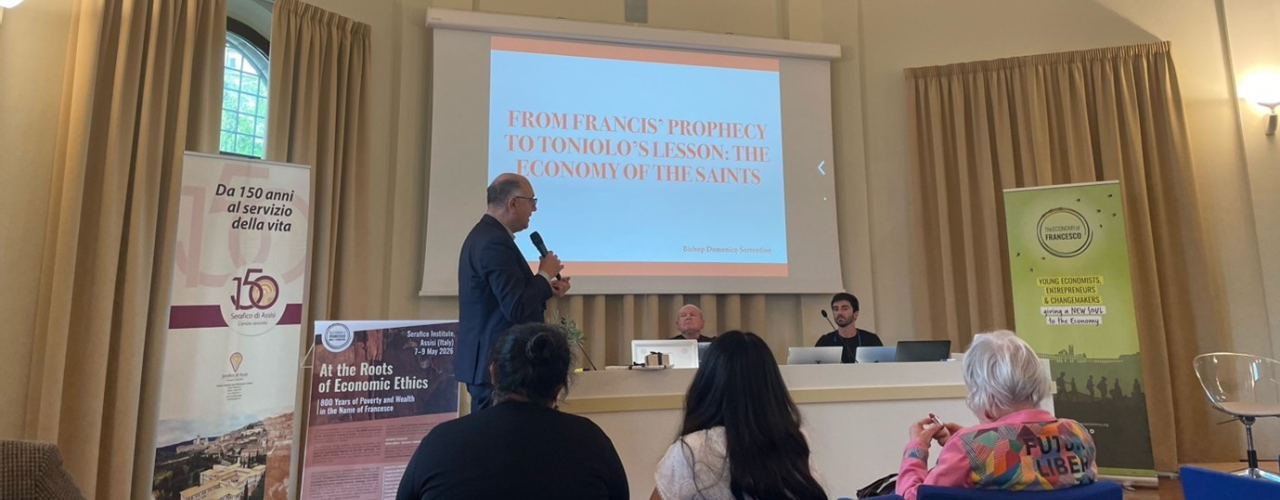
This past weekend, I was lucky enough to attend and present at an Economy of Francesco conference, held over three days in Assisi. The conference, ‘At the Roots of Economic Ethics’, celebrated 800 years of Franciscan thought, and explored existing and potential contributions of Franciscan and Catholic theology to today’s economy. It welcomed contributors from all over the world, across many disciplines.
The conference began with a brilliant lecture from Sr Helen Alford on the possible implications of St. Francis’s mendicancy (his total dependence on alms) on how we view economy today. Other lectures on Franciscan thought came over the next few days from experts like Giacomo Todeschini, Luigino Bruni, and Bishop Felice Accrocca and Emeritus Bishop Domenico Sorrentino. Their longstanding commitment to the Economy of Francesco, coupled with the presence of so many people seeking a more ethical economy truly inspired hope.
No less significant was the setting of the conference. It was held in the Serafico Institute, an organisation devoted to the education, support, rehabilitation, and advocacy for children and adults with disabilities. In a visit to Serafico in 2013, Pope Francis noted “We are among the wounds of Jesus,” and “these wounds must be heard!” The halls of the Institute were lined with artworks and projects made by those supported by the centre: reminders of the value of life always above and before ‘growth’ and ‘profit’.
Breakout sessions over the few days revolved around topics like debt, migration, and development among others. Standout presentations that I attended included a discussion of epistemic injustice in communities of abject poverty by Bruno Tardieu; about disability inclusion in public policy in Mozambique by 17-year-old Nicolye Mondle; and a matrix for assessing the social impact of businesses by Juan Carlos Mondragon Quintana.
Community Wealth Building in Dublin
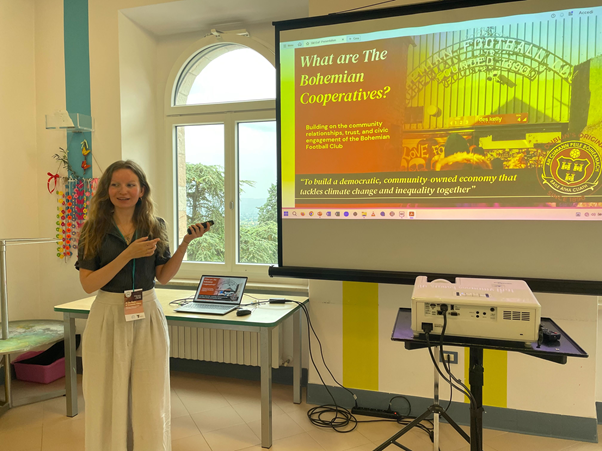
For my part, I presented on JCFJ’s collaboration with the Bohemian Cooperatives. The Cooperatives are project rooted in Community Wealth Building (CWB), having launched their Strategy Plan for delivering a CWB hub and two cooperative businesses in Dublin just last week. My work has involved research into bridging the rhetorical gap between the language of Community Wealth Building and principles of Catholic Social Teaching. The goal is to find a common language to ensure that this vision of a new economy includes as many participants in civil society as possible.
Put another way, which aspects of Catholic Social Teaching can serve as a theological frame to the Community Wealth Building paradigm and the Bohemian Cooperatives initiative, so as to extend their appeal to a church audience?
CWB is an economic model that generates, circulates, and retains wealth in communities, within ecological limits. This is achieved by encouraging anchor institutions (schools, hospitals, local authorities) to buy from local enterprises; and promoting the establishment of worker-owned cooperatives. Using the paradigm of CWB ensures climate action by economic design. That is, providing a community with local, stable jobs and a democratic economy that directly benefits them rather than distant shareholders challenges existing, extractive models of the economy.
Catholic Social Teaching (CST) reflects many of the same values as CWB in imagining an inclusive economy. Papal documents like Caritas in Veritate, Laborem Excens, and Laudato Si as well as heterodox economics like Civil Economy and Cooperative Enterprise were among the texts that informed my discussion of dignity in work and ethical economy from a theological perspective. Principles of CST like Solidarity, Care for Our Common Home, and Human Dignity are also key cornerstones.
Among these is the principle of Subsidiarity, developed 135 years ago today by Pope Leo XIII in Rerum Novarum, which recognises that there is an uncompromisable dignity in enabling people to make decisions on what they need at the most local level. In this way, people closest to the decision are able to innovate and implement their expertise and exercise initiative, freedom, and responsibility.
There is much precedent for this work. Among the most famous examples of Cooperatives is the Mondragón Corporation. Mondragón was founded on the efforts of Catholic priest Fr José María Arizmendiarrietta in response to the social tensions, alienation, and extreme levels of unemployment following the Spanish Civil War.
As important as Mondragón is in the genealogy of CWB, the church has been greatly involved in community development and cooperative movements in Ireland too. Examples include the involvement of Fr Eddie Coyne S.J. in the credit union movement and the foundation of the Irish Co-operative Organisation Society by Fr Tom Finlay S.J.
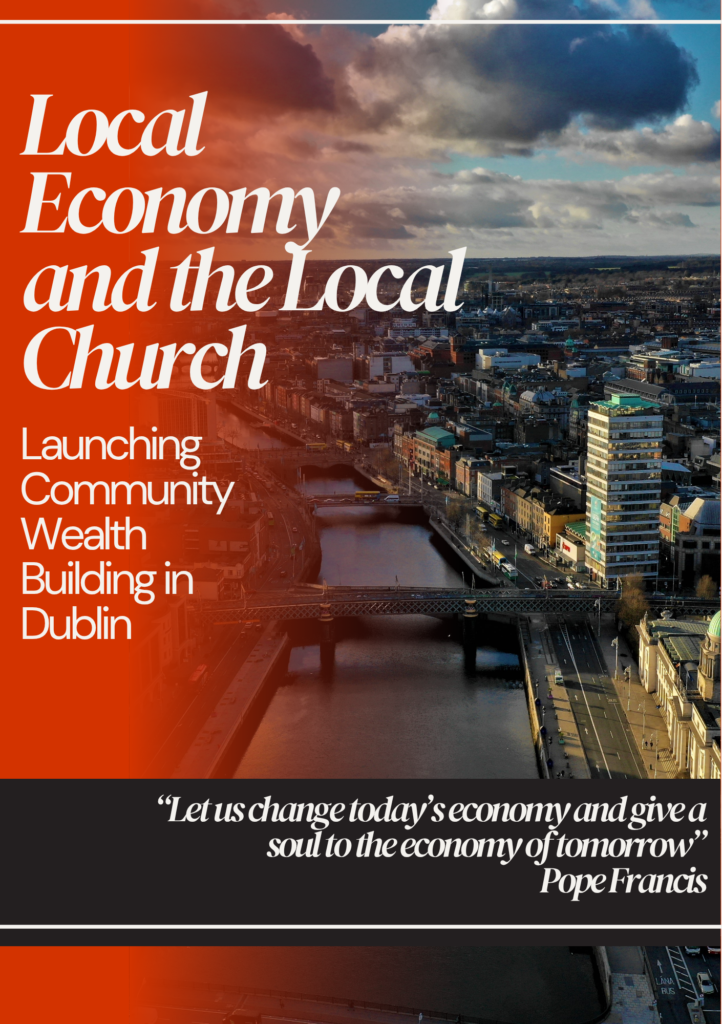
Ultimately, the culmination of the research has been the production of a pamphlet, aimed towards church audiences to promote the Bohemian Cooperatives. In this way, the Cooperatives can act as a practical pathway for people to realise an ethical economy based in Catholic social doctrine in Dublin. (If you want to read it, check it out at the end of this blog!)
Hope for the Economy of Tomorrow
Economist and Vice President of the Economy of Francesco Luigino Bruni spoke about the prophetic yet unaccomplished nature of St. Francis’s thought. Bruni showed that for Francis, every possession is a common good, such that when wealth is distributed amongst many possessors it makes the many richer, rather than when it is possessed by the few. In this way, it is like divine agape—what is ‘ours’ never diminishes what is ‘mine’. While the wisdom of Francis’s poverty is lost in our present economic culture, Bruni made the point that the European market economy begins with the collaboration between Franciscan friars and merchants. From its inception, the market economy has interfaced with philosophical and theological values, meaning that there is scope for faithful values to once again be reflected in our economy.
Particularly striking to me was the openness that everybody had to one another’s efforts. It did not go unacknowledged that in building an economy with a soul, as Pope Francis put it, requires the participation of people involved in extremely diverse kinds of work, research, and entrepreneurship. This willingness to dialogue and encounter; to reflect with others made the conference deeply meaningful. I was left with a very strong feeling of hope. Hope, more than anything else, can generate sustained action against economic injustice, because of its transcendent dimensions; because it is rooted in something beyond.