


Ireland has a profound congestion problem. Decades of under-investment in infrastructure have left our highways and even by-ways clogged with far too much traffic. The cost of this backlog to Dublin alone is estimated by a sober government-published report to be in the domain of hundreds of millions of euros every year. For a range of reasons – which all ultimately arrive at “we didn’t have any money” – when the rest of Europe was installing underground rail in capital cities and traversing their nations with motorways, Ireland was busy trying to get universal secondary education established. We too easily forget the awful starting point faced by the nation, partitioned and straight into a civil war. That the Republic was established and prospered is remarkable.
But when we had a chance to develop our infrastructure in the 1990s, we settled just on motorways. Two short, disconnected tram routes were installed in Dublin, but otherwise we entirely neglected our cities and our national public transport system. The DART line that runs the coastal length of Dublin is, infamously, still trying to operate with technology from the better part of half a century ago.
The last government sought to reverse these sad trends. A remarkable commitment to spend a million euros a day on active and public transport bore astonishing fruit as hundreds of new bus routes were developed and the beginnings of a patchwork of better cycling and walking paths were initiated. These developments are increasingly popular with the growing number of people who use them.
And yet, every time a new initiative is proposed, it is met with astonishing popular opposition. A plan to reorganise the village area in Lucan received thousands of objections. Local businesses suggested that the new arrangement, which sought to restore the sense of place to a village that has largely become a traffic route, would cost 700 jobs. The radical proposal that incited such a response? The removal of ten parking spaces. The plan was not implemented. Lucan village remains a perpetual traffic jam.
It is not just larger-scale developments that inspire opposition. In the small Galway town of Headford, modest proposals to make the roads around schools safer have generated opposition with local businesses again suggesting that they might be driven out of business by the installation of a new zebra crossing to allow children to cross the road more safely. We can also consider the residents in Cork who insist that a cycle path would endanger their children.
While we might marvel at a large solar farm being blocked because an aristocrat wants to protect their hunting routes, or a petrol station objecting to a bus corridor that was planned before it even opened, the most remarkable recent case must be the set of objections to the Dublin metro by the residents of a very prosperous square in south Dublin. Rather than entertain a long and drawn out process, the government has decided to buy out the entire development. Presumably at a price significantly north of what the already over-heated market would offer.
While we can understand the rationale behind that decision, we cannot be surprised if it inspires a raft of similar objections from people hopeful of a quick buy-out on future projects.
There are cautionary tales aplenty for these objectors. The red line of the Luas was meant to run straight through Inchicore village. The local businesses objected because they presumed – as businesses so commonly do – that their trade was dependent on motor cars. They successfully had the tram routed away from them. And the village has been in a long decline since then. The traffic is worse than ever, but the footfall is dislocated to the public transport system.
And this is the irony at play in the objections that we see to public and active transport infrastructure – they induce a sort of collective amnesia. One the track is laid, or the kerbs are installed, the dire warnings of economic collapse and social ruin simply evaporate.
Take, for instance, the well-resourced objections to the Dublin Transport Plan, which predicted economic catastrophe if a series of phased, well-considered, minor modifications were made to encourage bus and cycle traffic along the quays were to go ahead. In the end, the changes were made. And the retail giants who funded the report saw their sales grow. Indeed, in a paragraph quietly hidden at the back of a report, the car park owners in the city centre confessed that the changes they expensively opposed had actually been positive.
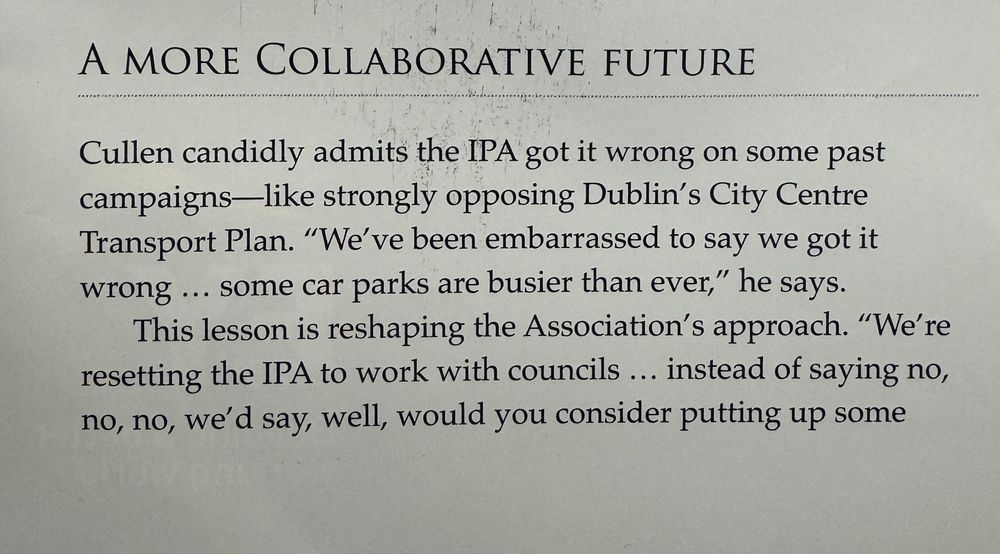
Excerpt from “Irish Parking Association; Evolving to Meet Modern Challenges” in the most recent edition of Public Sector Magazine
This pattern repeats across the country. Greenways are painfully developed along the routes of abandoned railway lines and then become the crown jewels of local tourism. Visit Dungarvan or Achill and ask the locals now if they want their routes ripped up. When Grafton Street was first pedestrianised, more than a generation ago, it was going to destroy the entire road. Similar cries were made about Capel Street. Grafton Street is one of the most prestigious retail locations in Europe and Capel Street is considered one of the coolest streets in the world. Any plan to bring private motor traffic back to these streets would be laughed out of the city council.
The disconnect lies in our inability to imagine a version of our neighbourhoods that isn’t dominated by the private car. We treat the loss of a parking space as a violation of our civil rights. As the Canadian activist Tom Flood has put it, any distance is walkable, as long as we are walking from a parking space. The daily danger faced by children trying to walk or cycle to school is minimised by the need to set apart public space to store citizens’ private possessions.
The “veto culture” is often motivated by the desire to seek an easy payout. There is something fundamentally tawdry about this and we should not be ashamed to comment on it. An attitude prevails that if you can extract a little compensation bundle from the government, you would be a fool not to take it. But that approach dilutes our democratic right to object on solid grounds. And fundamentally, that money doesn’t come from “the government”. It comes from me and you. There can be a complex dishonesty at play here.
The veto culture needs to be challenged. We are failing to meet our climate targets. Congestion is stifling our quality of life. The rate of road deaths rises. And even when it isn’t motivated by whingeing, there is something depressingly reactive about this objection culture. The people currently ranting about a proposed cycle lane will be delighted when their kids can cycle to GAA training on their own. The people lamenting at the waste of money involved in a new train line will be checking the (hopefully functional!) real-time app in a few years as they commute much faster and much cheaper.
The challenge for our planners – and for us as citizens – is to look past the temporary inconvenience of change to see the permanent benefits of living in an Ireland fit for this century. We have spent decades catching up; we cannot afford to let ten parking spaces stand in the way of our continued progress. Prioritising the common good over individual convenience is not just a planning necessity but is a requirement for an inclusive, just, and sustainably flourishing society.


