

Climate change is here. There is no question. The years of warning what’s to come if we don’t change our ways has caught up to our present, pointing the finger to human induced climate change. Deadly heatwaves, droughts, glacier instability causing devastating destruction and loss of life and flooding are our prevailing reality now. The question of what climate change will be like is answered, with the next question on our lips being: how bad does it have to get before we take serious action?
This is a question I would like to put to the current Irish Government. Their scattergun policies relating to climate, environment and transport does not fill me with much hope of a coherent answer but my fear is the defining feature of their policies is a certain level of cognitive dissonance.
Climate action – just not this one
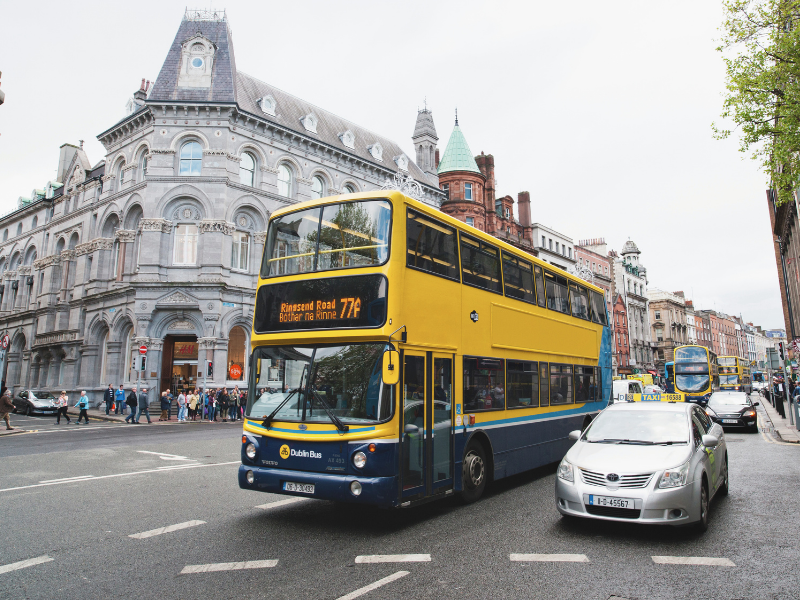
The latest example of the Government talking out of both sides of their mouth came this week when Minister O’Brien stated that “as we move towards 2030, there is an urgent need to accelerate and strengthen climate action”, then the NTA announced an increase in public transport fares. In a cost-of-living crisis, this is an almost unbelievable action which will put an additional cost pressure on a group of people who are choosing, or have no alternative but to choose, the more sustainable mode of transport. Put in the wider context of the Governments continued subsidisation of private cars through a cut in excise duties, a bleak picture is painted of the Government’s priorities when it comes to climate action. The effective result of this action is that public transport users are going to be paying for the cheaper fuel costs of people driving cars and a potential loss in the number of people using public transport.
Unfortunately, this decision to increase fares is not a one-off ‘regrettable’ incident necessary to increase the widening of the public transport network. It is one of many policy decisions which systematically undermines efforts to reduce the dominance of the car in the Irish transport system, a system which has resulted in Ireland having one of the highest per capita transport emissions in Europe. Last month the NTA announced that it has insufficient funding to advance public transport services, with existing and planned projects under pressure from lack of funding. The Galway ring road on the other hand has a green light with guaranteed funding, even though the modelling of the road indicates that construction of the road will not ease congestion and will inevitably lead to more cars on the road. E-bikes and e-scooters are being regulated for safety reasons, but the mammoth beasts of cars, which are now a regular sight on the road, have no additional hurdles to pass to be allowed on the road. Even communities begging for road safety measures which would allow people to walk more safely around their villages and to recreational amenities are being ignored.
Advisory Council advice – take it or leave it
In June of this year the Irish Climate Change Advisory Council published a report on transport. In it they stated that “Ireland must reduce this exposure (to fossil fuel price shocks) by accelerating investment in public transport, active travel, electric vehicle charging infrastructure and the grid capacity needed to support cleaner transport.” In response to the news of the hike in fares they said it was regrettable and that the recent increases in public transport use could be reversed. Their views on this topic could not be clearer and yet the current government are refusing to listen.
The actions of the government show incredibly clearly that climate change, and the deadly serious consequences that are happening right now, are not a high priority. They sometimes say the correct things, they express desire to be leaders in the space and ambition to do better but they ignore the council they appointed to advise on the subject. While this response may not be a perfect example of cognitive dissonance, the holding of two opposing values at the same time, it might be even worse. This government might know the impact of climate change, they might know what they should do to try and slow the impacts (they certainly know who they can ask), but they don’t care enough to actually do it.
We need to find a way out
At JCFJ we know that transportation is not just an environmental issue – it is a deeply social issue. How we design the systems we use to get around, how much they cost and who’s safety is prioritised in these systems matter. Transport is one of those issues that the problems are so ubiquitous that we can become collectively blind to them. Finding new ways to see these systems and the inherent safety issues is an incredibly important part of changing the system as a whole. Along with other sustainable transport advocates, we have invited Tom Flood to give a public lecture on ‘Reframing Road Safety’ on 22nd September in Trinity College Dublin. Demand is so high for this lecture that we recently changed the venue to more than double the capacity. People know the system is broken, we know things need to change and collectively we can call out the government. They can’t ignore us all.


