

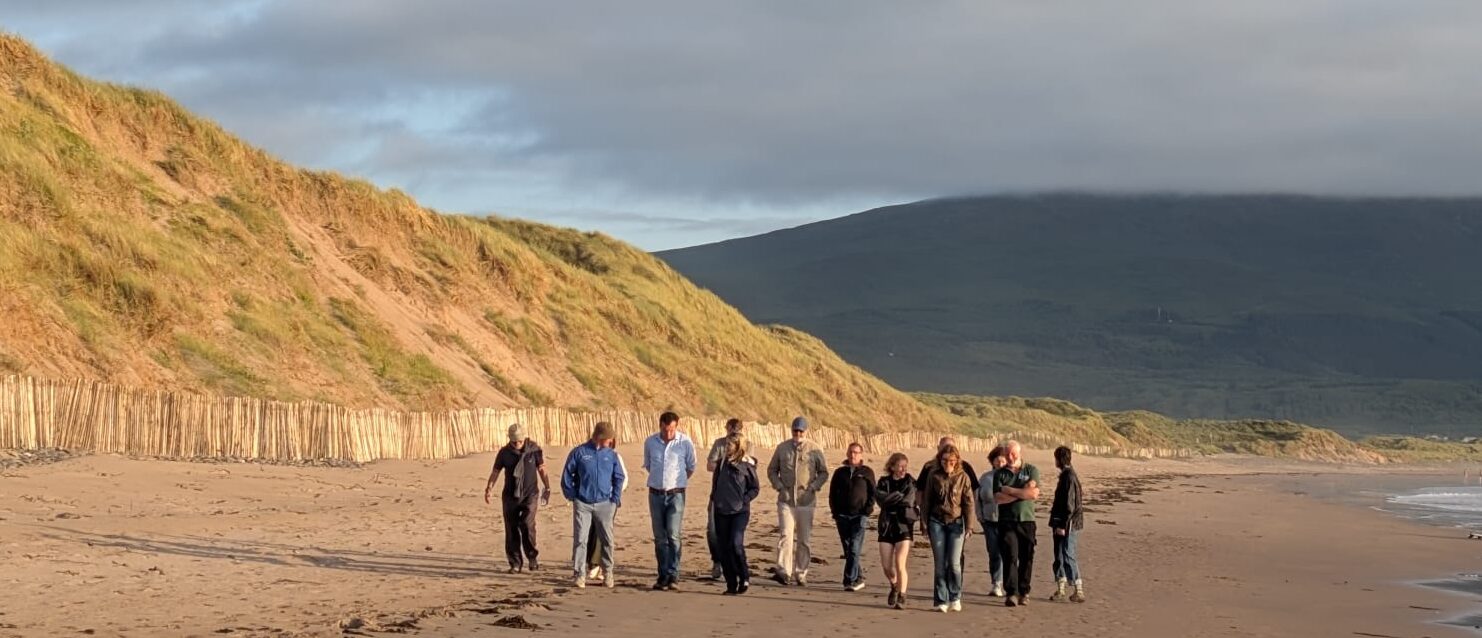
Operating on the Dingle Peninsula in Co. Kerry, Dingle Hub is a non-profit company that specialises in local activation of communities for climate initiatives. Last week they convened a Teacht le Chéile, a coming together of people from civil society, local government and state agencies. The purpose of the gathering was to show what they have achieved, to explain how they have achieved it, and to invite future collaborations. JCFJ was delighted to be invited and to participate.
What is Dingle Hub?
After feasting on what is surely the best pizza in Kerry, if not Ireland, Deirdre de Bháilís, General Manager of the Dingle Hub, presented the history and work of the Hub. She described it as a Local Intermediary Body and a Community Activation Hub. The Hub occupies a gap that exists between individuals, organisations and businesses at local level, and the state agencies and semi-state organisations that are charged with implementing national environmental policies and initiatives.
If policies are to be implemented, advocates and organisers who know the relevant local actors and resources are a crucial part of the desired transition. This piece of the transition process is often overlooked.
By way of example, when the state adopted a policy of retrofitting houses with solar PV, Dingle Hub signalled the potential commercial value to local electricians, and enlisted them to train up in the installation of solar PV. The Hub then leveraged its relationships to facilitate the creation of Sustainable Energy Communities (SEC) of local dairy farmers and the local tourism and hospitality sector.
We heard two stories of trees. In one instance, a farmer received a free delivery of trees from a state agency to be planted on his land. Two months later they were still lying in his barn as the farmer did not have the time or energy to plant them in the ground. Another farmer also received trees. The Hub arranged a meitheal of local volunteers who took great delight in planting them.
These examples highlight the role that relationships and goodwill play in the implantation of policies. Dingle Hub has honed the art of making these essential connections.
The importance of trusted change
The Dingle Hub contrasts the way it works with other implementation strategies. Rootedness is the visual image that works best here; they describe their work as a process of ‘scaling deep’ rather than scaling ‘up and out’. This process prioritises place-based assets and trust for its community projects. Place-based assets include everything from the incredible geography and natural landscape, to local culture, community knowledge, networks, and social attachment.
Core to this approach is trusted change in communities. The two different stories of reforestation on farmer land exemplifies this. In one instance, a top-down approach assumes the work is done when all of the right pieces are in the right place. The trees are on the farm. But this fails to engage with the farmer, who is then left with the work of coordinating the planting of hundreds of trees on their land.
For Dingle Hub, relationships take priority. They foreground local networks and engaged volunteers to arrange the meitheal, and, in so doing, they build trust. The change is therefore more lasting, and further climate action measures—such as setting aside land for rewilding and biodiversity—become more appealing.
The Church and local development
On our second day, as we walked through Castlegregory, a local poster of the village’s history was pointed out to us. It was a collage of photos from the previous century of life in the village. Among them, photos from the agricultural co-operatives, and of John Mark and Mai Egan, who ran the ‘Country Store’ for decades. They were core members of the community, remembered fondly by locals. John Mark was also heavily involved in Muintir na Tíre.
Muintir na Tíre was founded by John M. Canon Hayes in 1937. Himself from a farming family that had faced eviction, Fr John saw the multitude of economic difficulties faced by his parishioners in Tipperary as the newly formed Republic forged its economic policies. Muintir na Tíre was set up to develop rural communities through the participation of people in those communities. Hayes was particularly influenced by the encyclicals Rerum Novarum and Quadragesimo Anno. The explicit aim of Muintir na Tíre was for every member of the community to be working towards the common good, across all sectors of society.
The agricultural cooperatives, too, were built up with the aid of clergymen. Fr Tom Finlay, S.J. was Vice President of the Irish Agricultural Organisation Society (IAOS), and promoted the cooperative model in Church circles while lecturing as Professor of Economics in UCD.
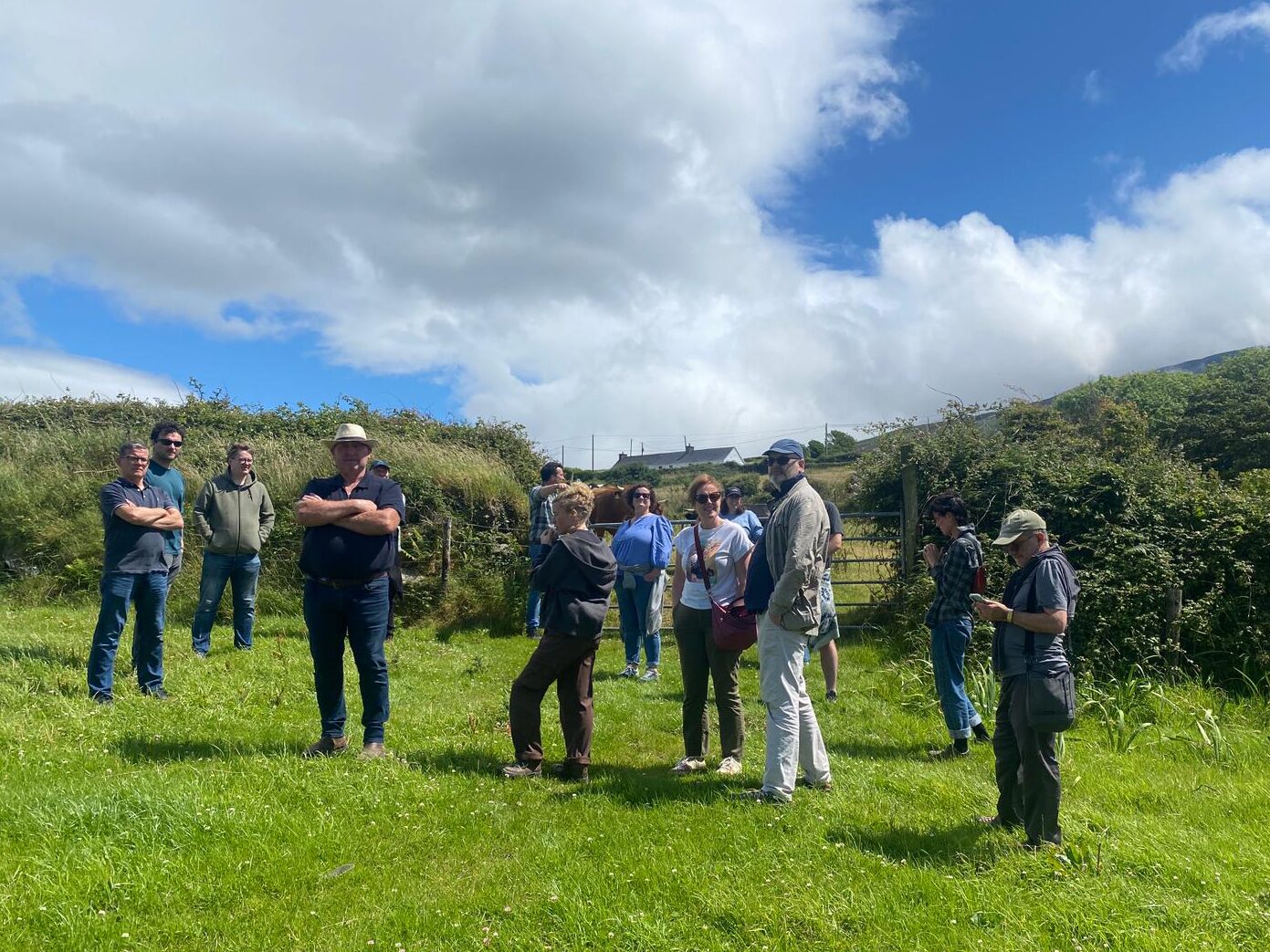
Like the cooperatives and Muintir na Tíre in the 20th century, Dingle Hub operates today on what could be described as principles of subsidiarity—empowering the community at its most local level to pursue the common good.
On our visit, we encountered many success stories of this approach, from dairy farms and businesses involved in the local SECs to sand dunes that towered above us thanks to the work of the Maharees Conservation Association. Here in Dingle, the story of subsidiarity in action continues.


