

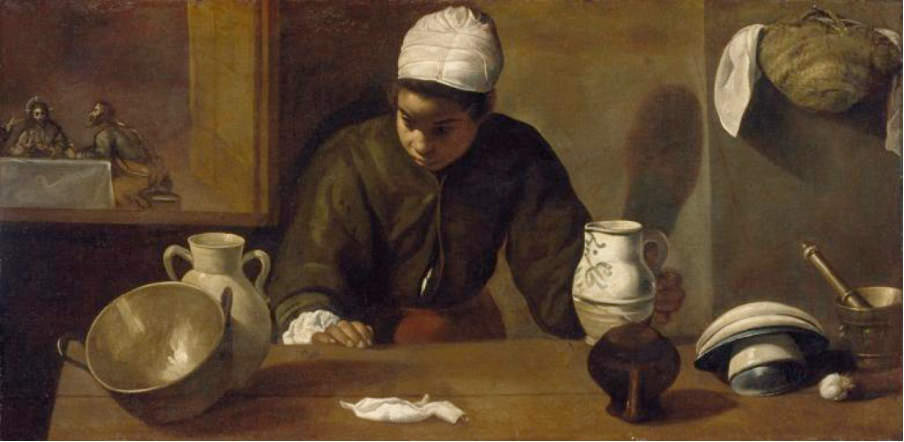
“Do not forget to show hospitality to strangers, for by so doing some people have shown hospitality to angels without knowing it” (Hebrews 13:2).
New Rules
In the new package of restrictions on citizenship being proposed by Jim O’Callaghan, the Minister is keen for Ireland to become tougher on migration. The current requisite five years of residency in order to qualify for citizenship is being increased to eight. An English or Irish language competency test is being considered. Applicants for citizenship will be required to be economically self-sufficient, and not be in receipt of welfare payments prior to their application. All of this is ostensibly to promote integration for people seeking Irish citizenship. It is a thin veneer for the increasingly pernicious anti-immigration stance that the current government is pursuing.
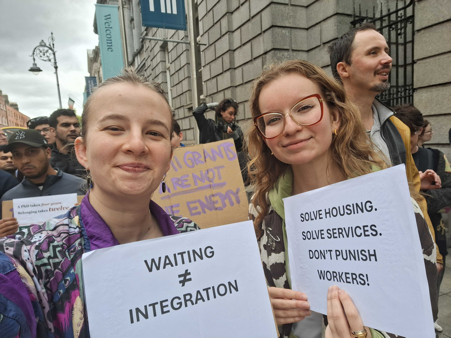
Yesterday, my colleague Cherise and I attended a demonstration against these restrictions. There were many people in attendance (especially considering it was lunchtime). Chants and signs demanded to “Keep it five” and asserted that Ireland needs migrants just as much migrants need Ireland. Green Party Deputy Leader Hazel Chu pointed out to the many migrants present that this legislation does not change whether or not they belong. They already do.
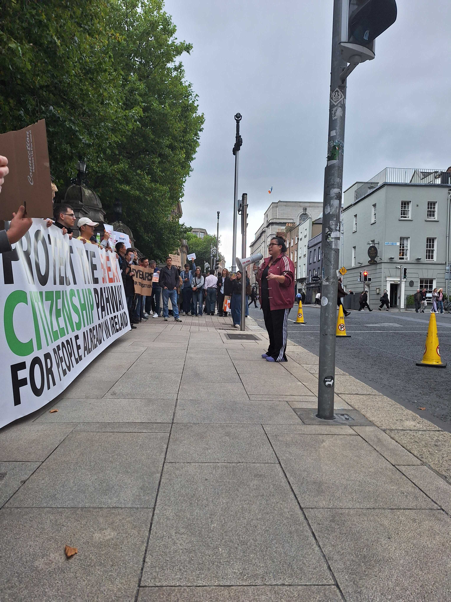
Of course, no constituent—anti-immigration or otherwise—will have approached their TDs concerned that five years is too short a timeframe for migrants to integrate and be considered for citizenship. No constituent has called Jim O’Callaghan demanding that the arbitrary number of years of residency be increased. There is no functional difference between five years and eight. Rather, this is empty legislation that furthers the Minister’s political agenda by appealing to anti-immigrant voters.
It achieves very little except disheartening those who are already working, studying, worshipping, raising families—those who are already living—in Ireland. Those who have chosen to study in Ireland, who have already spent years and sometimes decades in Ireland, will have to wait even longer for their belonging to be recognised by the State. Moreover, there is no indication of who and how (and with what time and resources) the language tests will be administered. Firmer stance on migration indeed. As one poster put it, “Waiting ≠ Integration”.
A Two-Way Process
In actuality, integration is a carefully defined concept, both academically and within Irish and EU legislation. As our report on faith-based communities in the north-east inner-city showed, integration is defined as a “two-way process”. This has implications for both the migrant and the receiving country. We should ask ourselves not only how migrants integrate into Ireland, but how does Ireland integrate for migrants?
The governments 2017 Migration and Integration Strategy makes this explicit: “As a two-way process, integration involves change for Irish society and institutions so that the benefits of greater diversity can be fully realised.” By doubling down on nothingburger policies that stoke the fire of increasingly popular and increasingly violet anti-immigrant sentiments, we foreclose the possibility that migration grants us. We sink into protectionism based on unfounded fears, and, in so doing, isolate ourselves from the rich contributions of people from outside of Ireland.
The Road to Emmaus
A few doors down from Leinster House is the National Art Gallery. I am always surprised by the richness of our national art collection. Some months ago, I discovered that we had a painting by the Spanish artist Diego Velásquez, of Las Meninas fame. Upon researching the painting further, I found that it has a sister, housed in the Art Institute of Chicago. Here is what that version looks like:
The Kitchen Maid, Diego Velásquez
Velásquez lived and worked during the 14th and 15th centuries—an age of exploration, and colonisation. We might say it was a time of migration. And while his subjects ranged from popes to princesses, here, as in a lot of his earlier work, he focuses on a humble scene of a maid in a kitchen, cleaning up or preparing a meal. Her attention is elsewhere, though, as she seems to overhear something.
Here is the version that hangs in the National Gallery:
Kitchen Maid with the Supper at Emmaus, Diego Velásquez
What appeared to be an ordinary scene is revealed to be extraordinary. Through a window, or a hatch, it turns out that the meal being prepared is none other than the one shared between Jesus and the disciples on the road to Emmaus.
After the resurrection, two disciples are walking to a small village and they meet a man on their way. He is entirely unaware of the scandal of Jesus’s crucifixion and resurrection three days later. They walk with him and explain the events of the past few days. As they reach Emmaus, the man walks ahead, as if to go on alone. They stop him, as it is almost night time. They urge him strongly to stay with them. And he does. At their table, they share a meal, and it is only when Jesus breaks the bread that their eyes are opened and they recognise him. As soon as they do, he disappears. What appeared an ordinary journey has been revealed to be extraordinary.
This is the scene in The Kitchen Maid. In Velásquez’s painting, Jesus and the disciples are in the midst of their meal. By Jesus’s presence, we can confirm that the disciples are still none the wiser to his presence. But the maid’s head is cocked: she seems to sense the presence of God. Discussing this gospel story, theologian Luke Bretherton points out that in this story, Jesus is both a guest in their home, and subsequently the host.
The Significance of Hospitality and Strangers
Through this instance of hospitality, “strangers see each other in a new light, enjoy fellowship, and Jesus is understood to be the risen Lord—something new has emerged that ruptures their existing beliefs and practices.” The disciples go forth from this village to Jerusalem as witnesses of the risen Christ. Crucially, this recognition and witness can only occur after offering hospitality. We can read this into the painting: the maid recognises Jesus first because she has presumably made the meal for him.
In the Biblical tradition, there are many injunctions to welcome strangers, e.g. “When an alien resides with you in your land, you shall not oppress the alien.The alien who resides with you shall be to you as the native-born among you; you shall love the alien as yourself, for you were aliens in the land of Egypt: I am the Lord your God.” (Leviticus 19:33-34). This exhortation is not exclusionary. In the words of Pope Francis “love does not care if a brother or sister in need comes from one place or another” (Fratelli Tutti, §62). Alien does not mean ‘person I know’, ‘person who looks like me’ or ‘person I agree with’.
Rather, we are told to love even our enemy. Jesus proclaims “And if you greet only your own people, what are you doing more than others? Do not even pagans do that?” (Matthew 5:47). We are called to more. This is a challenge, but it is in these conflictual encounters that we are most likely to encounter God (Hebrews 13:2). To shirk this challenge is to put our faith in the false belief that we can be self-sufficient without God, and without one another.
This little scene of the kitchen in Emmaus is going on, in perpetuity, just a few metres away from the halls where the new citizenship rules are being deliberated on. Does eight years of residency sound serious enough? Should it be ten? Should immigrants maybe wait fifteen, twenty, fifty years to really prove their allegiance to the Republic? How better can we make migrants feel unwelcome? How can we limit our encounters with others? As the debate goes on, we ought to remember that these laws distance us from the possibility of encounter with Jesus. It is only through hospitality that we can hope to receive a blessing.


