

“The Pope is weak on crime.” At first glance, one struggles to make sense of it. How can it be that this is something that the American President has said – published, indeed – in an attack on Leo XIV so broad that an ardent Free Presbyterian would wince to read it.
The rant was a response to the Pope’s consistent message that world leaders have a responsibility to pursue peace and to avoid war wherever possible. It seems he angered MAGA leaders when he preached that “God does not listen to those who wage war.” The uncomfortable detail for Christians in the Trump administration is that this is a near-to-direct quotation of Isaiah 1:15.
Religious themes have been unavoidable in global political discourse in recent weeks. Alongside broadsides against the Papacy, President Trump uploaded an image presenting himself as a Messianic healer. In another post, he appears in an embrace with Jesus alongside text suggesting that in the battle between good and evil, “God might be playing his Trump card.”
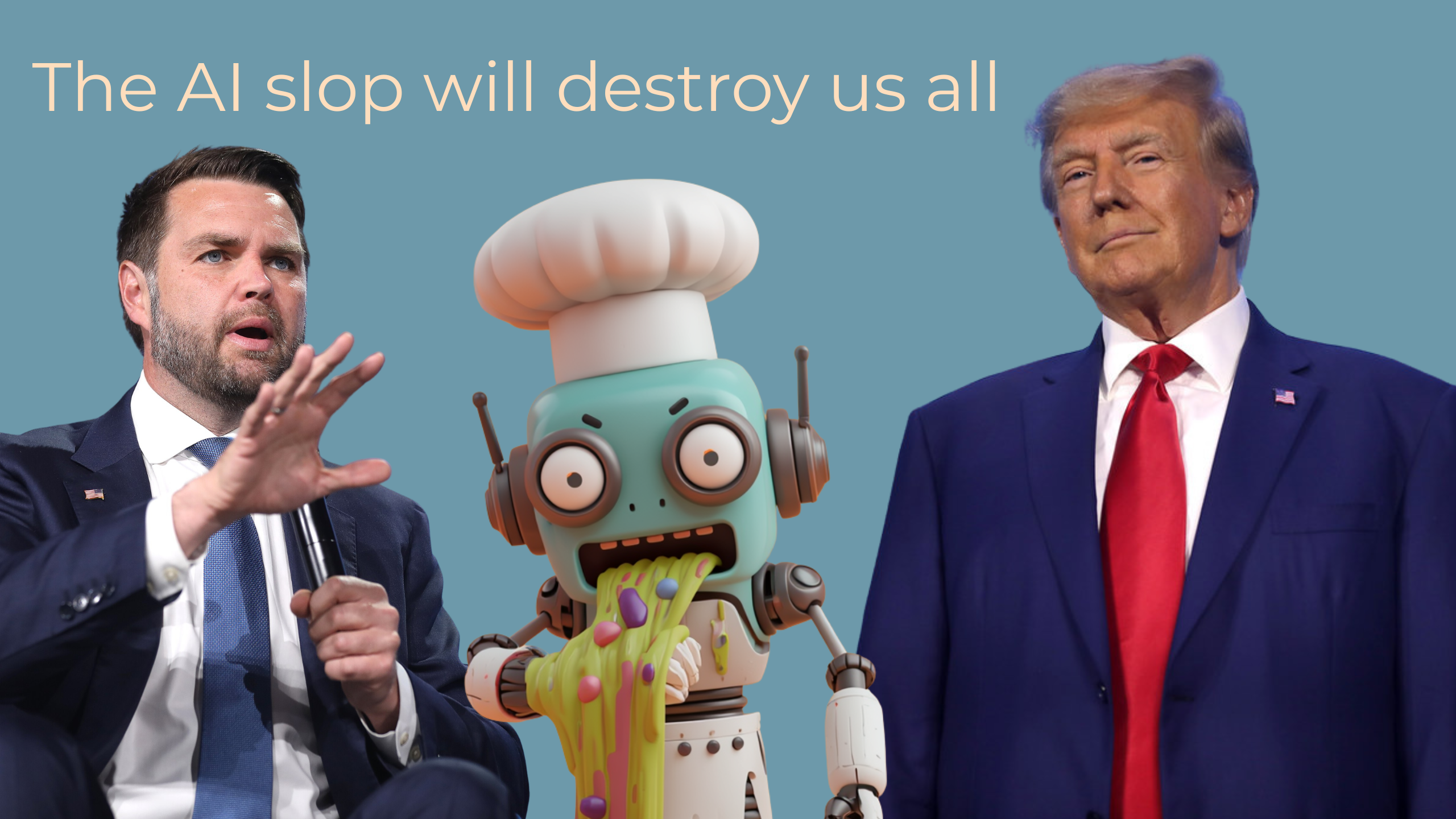
There was widespread dismay at Trump’s comments, but his inner circle was ready to defend him. His Vice-President, J.D. Vance, suggested that the Pope “should be more careful when talking about theology.” As a relatively recent convert to Catholicism, Vance may not be best placed to offer such feedback. And the Speaker of the House, Mike Johnson, confessed that he was “taken a bit aback by him [the Pope] saying something about ‘those who engage in war, Jesus doesn’t hear their prayers’ or something.” After all, Johnson – a Southern Baptist – reminded his audience, “There’s ‘Just War’ doctrine.”
A rational immediate response to these kinds of proclamations is to decry the influence of religion on politics and to commit to excising this kind of speech from the public square. The old anti-clerical line about how religion inevitably leads to conflict seems pretty sound when you consider these kinds of statements.
But looking more closely, what we find in all of these interactions is not a surplus of religiosity but its deficit. Trump’s depiction of himself with a transfigured glow bringing about miraculous healing rightfully strikes people as egotistical, not faithful. Vance seeking to correct the Augustinian Pope on the niceties of Augustinian Just War Theory is not a serious engagement in important philosophical dispute but a transparent tribal appeal to trust Trump and suspect anyone who dares to differ with him. What we are dealing with here is not the invasion of the global public square with fervent religiosity but the appropriation of religious concepts and images for the sake of a political agenda. This is political kitsch in the key of American cultural Christianity.
It is striking that no journalist has either had the courage or the capacity to press further on the points that these political leaders made. Vance was heckled by his own audience, but no one has formally cornered him with how he squares the attack on Iran with the criteria of Jus ad bellum and Jus in bello (to say anything of Jus post bellum). Trump deleted the initial Christ-like image and brushed the controversy off as “fake news”. But no journalist has dared to press him on how he reconciles all this with the central place of humility in Christian tradition or the long and dark history of anti-Catholicism in official American life.
It is attractive to think we can respond to these provocations by just walling off the public square from religious speech. But this is a naïve presumption. America, after all, invented that wall of separation. We can see how well it is working for them. What is needed instead is a familiarity with religious ideas. Only when you know what these ideas mean can you critique them or retrieve them.
The recently deceased German philosopher, Jurgen Habermas called this “post-secularism”. Instead of recoiling with a sort of 18th century allergic reaction to religious speech as fundamentally irrational, it grants that religious communities offer a vibrant contribution to our social fabric and including those neighbours means being able to understand where they are coming from.
The British political scientist, John Heathershaw, has explained how it is the absence of theological fluency that allows these kinds of dangerous fiascos to unfold. It has been the policy of all the Steve Bannon-inspired political movements to “flood the zone”. The most effective way to puncture the vast web of religiously-themed lies, half-truths, and algorithmic delusions is apocalyptic argument. Apocalypse, after all, doesn’t mean “the end of the world” but unveiling. The extent to which this is news to people – considering this is a very basic theological genre that Christianity brought with it from Judaism – indicates how little the average educated, informed person understands how religious ideas actually work.
Heathershaw says: “The wider purpose here is apocalyptic: it is about unveiling the lies we tell ourselves. Lies which keep the political world turning but cause untold human suffering. Telling about that suffering and its needlessness is an act of the apocalyptic.” Without this bold, prophetic, and authentically religious language, we are left with a public square that is defenceless in the face of Messianic ai slop and confident middle-aged men spouting nonsense as if words don’t have meaning. Heathershaw reminds his readers that St Paul instructed the Christians in Ephesus, almost exactly 2,000 years ago: “Let no one deceive you with empty words. … Take no part in the unfruitful works of darkness, but instead expose them.” The only way to expose them is to speak sense in the face of nonsense. Even the most committed secularist has to recognise that if political actors can hijack religious language so easily, you simply can’t expel all the religious voices. The antidote to heinous religious provocation is not to establish a secular cordon sanitaire but to engage hospitably with the real contributions that actual religious communities make. That takes the ground from under the “Christian nationalists” and makes space for real encounter and dialogue.


