
Colm Fahy
Colm Fahy is a JCFJ research fellow. A University of London graduate in history and international cultures, Colm has worked at Jesuit Social Centres in London and Brussels. He has followed UNFCCC conferences since COP26, leading multi-national Jesuit networks in climate justice initiatives.
Many countries in the world are set on reducing their financial commitments to international solidarity. Last year, USAID, the international aid fund of the US, hit the headlines when 83% of its budget was cut by the Trump administration. This move away from compassionate international solidarity has also been the case in Europe, with the UK, the Netherlands, and Germany following suit… but not Ireland.
International solidarity is something that, I feel, is very Irish. There is a tradition in Irish society of concern for the world’s poorest, and that is something deeply rooted in the country’s Catholic tradition. During the Biafran War in Nigeria in the 1960s, Irish society gave huge donations to a part of the world where many Irish missionaries were serving and where extreme war induced poverty was being experienced. This concern led to the foundation of many NGOs (one of them literally being called Concern) which, through fundraising in parishes and on the streets, sent aid to Nigeria in that desperate time.
Sticking with solidarity
When I was at COP30 in the Brazilian Amazonian city of Belém last month, I frequently met with Irish actors within government and civil society, and one thing was always evident: Ireland’s commitment to international solidarity in terms of finance is beyond doubt. At the end of the conference, Minister for Climate, Energy, and the Environment, Darragh O’Brien, announced €15.2 million in climate finance for Ireland’s contribution. This included a 60% increase in funding from Ireland to the Adaptation Fund to assist the poorest communities that are adapting to climate change.
Ireland’s commitment at COP30 demonstrated that this historical ethos remains strongly relevant in the face of modern global challenges. The summit itself focused heavily on climate finance, urging developed nations to work towards tripling adaptation finance by 2035, specifically to help the most vulnerable countries. Amid this push, Ireland’s announcement was not simply an obligatory contribution; it was a targeted, substantial increase directed squarely at the Adaptation Fund. While many larger economies were scrutinised for failing to meet their overall aid targets, Ireland emerged as a powerful counter signal, choosing to bolster grant based finance (money that does not need to be repaid) to communities that need it most. This proactive financial commitment affirmed Ireland’s position as an outlier, proving that the tradition of international concern is alive and influencing government policy today.
Openness to dialogue
Ireland’s commitment to dialogue with civil society organisations in Belém was also appreciated, with the Department of Climate, Energy and the Environment (DCEE) regularly meeting with the twenty five civil society actors which made up the Irish ‘overflow’ delegation. At these meetings, we had a chance to meet members of the Irish civil service who were in the thick of negotiations as well as a chance to question visiting ministers, which included Darragh O’Brien TD and Neale Richmond TD. When I spoke to overflow delegates of other countries, they found their governments were not met with such openness to listen.
Global Catholic and Jesuit presence
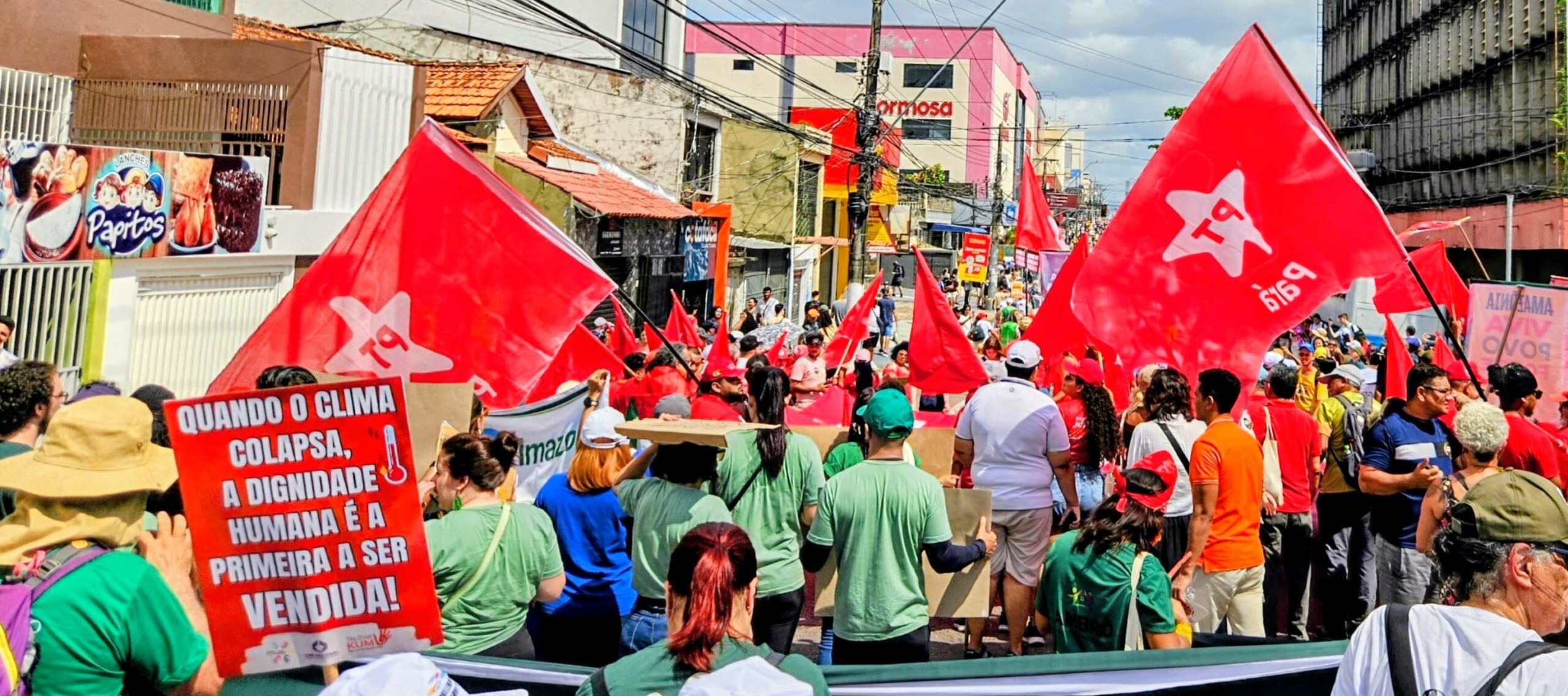
This Irish openness mirrored a broader, faith inspired movement within the summit. Driven by the same sense of mission, the Catholic Church’s strong presence in Belém offered a powerful testimony from the grassroots. Bishops spoke at various side events about how their communities suffer directly from climate induced disasters, while local and indigenous groups joined activist marches outside the main conference. Catholic NGOs coordinated professionally to ensure their crucial messages were heard by negotiators and decision makers.
The presence of the Jesuits was also powerful, notably through our Jesuits for Climate Justice campaign. This group of twenty Jesuits and lay collaborators followed the negotiations throughout the two weeks, participated in key side events, and hosted two receptions for those participating at COP. One significant highlight of this campaign was the opportunity to present a statement from the delegation to COP President André Corrêa do Lago, followed by a press conference hosted on the final day to speak about specific Jesuit demands.
One strong feature at COP was the working relationship between our Jesuit delegation, the official Catholic actors group, and the Holy See, who have been a permanent party of the UNFCCC since 2022. The delegates of the Holy See coordinated well with Catholic groups to obtain opinions and specialised advice as the negotiations went on. I chaired a working group on Just Transition where civil society organisations met representatives from the Holy See to give comments on the informal texts being developed on a Just Transition Mechanism. I found the Holy See to be as approachable and listening as the Irish.
Hard fought wins
The negotiations did eventually yield some hard fought wins for the world’s poorest. A key achievement was the approval of the Belém Action Mechanism, a new, permanent body proposed by civil society. This mechanism will track the global transition away from fossil fuels, providing essential resources and support to ensure that the livelihoods of workers, including miners and indigenous peoples, are considered during the shift to cleaner technologies.
We must remember, however, that as parties go, the Holy See is even smaller than Ireland! Decisions are made in influential caucuses, and smaller countries like Ireland are subject to the larger countries which dominate these. Ireland caucuses within the European Union bloc, which was the main opponent of our work to deliver a just transition mechanism. Additionally, internal conflicts within EU member states meant that the EU’s Nationally Determined Contribution was delivered late and is largely seen as incompatible with the 1.5°C target.
The domination of powerful countries within these caucuses far too often ensures that the interests of just a few hijack progress at these conferences. The most notorious of these caucuses is the Arab Group, led by Saudi Arabia, who speak at every possible chance in a charming, eloquent but quietly destructive tone. Fossil fuel phase out has only been mentioned once at COP28 (in the UAE of all places) and so COP30 was not unusual in that respect. It was, however, as one Dutch MEP, Mohammed Chahim, quipped to me, ‘like a fire fighters conference without mentioning water’.
The tradition lives on
So what were my conclusions of COP30? The Irish legacy of international solidarity lives on and is a beacon of hope alongside the work of faith based organisations and civil society actors who refuse to let the voices of the vulnerable be drowned out. Ireland proved that even smaller nations can lead by example, demonstrating that financial commitment to climate justice is both possible and necessary. Yet the conference also exposed the harsh reality of international negotiations: the blocking tactics of fossil fuel interests and the internal divisions within powerful blocs like the EU threaten to undermine the urgency demanded by the climate crisis.
As we move forward, the challenge is clear: we must build coalitions of the willing, amplify the voices of those most affected, and hold larger nations accountable to the same standards of solidarity that countries like Ireland have shown. One hope of this happening was the announcement of the first International Conference on the Just Transition co hosted by the Netherlands and Colombia, an avenue away from the UNFCCC to explore fossil fuel phase out. The tradition of concern for the world’s poorest is not merely a historical footnote; it must become the driving force of climate action in the years ahead.


